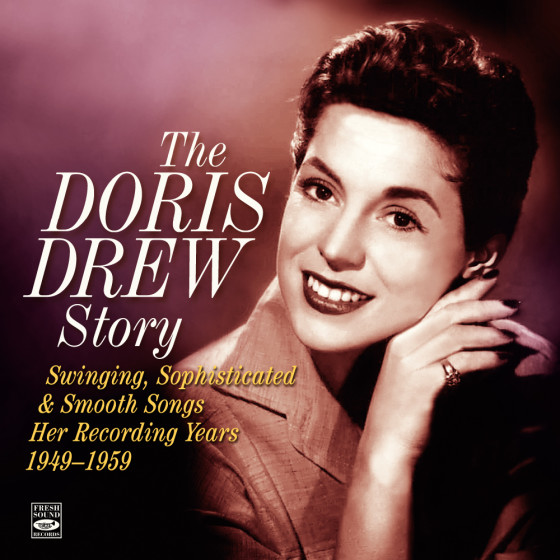
Doris Drew
Doris Drew, whose real name was Doris Gruen, was born in San Antonio, Texas, on August 23, 1927. At the early age of eight, her vocal inclinations began to manifest themselves. She participated in numerous school shows, putting her natural vocal talents to good use.
After her mother died at the age of 55, when Doris was just 14, she was raised by her aunt, Mrs. J.D. Harris. Doris had two brothers,Jack and Henry Gruen, and many relatives living in San Antonio. She attended Brackenridge High School, studied dancing at the Bonner Studio, and took piano lessons with Mel Winters. Her singing was admired by everyone, and she became very popular among her fellow students.
Following her graduation in May 1945, the school newsletter stated: “We’ll never forget the way Doris Gruen sings ‘Embraceable You.’” Doris began her entertainment career in 1946 while serving as a social hostess with the...
Doris Drew, whose real name was Doris Gruen, was born in San Antonio, Texas, on August 23, 1927. At the early age of eight, her vocal inclinations began to manifest themselves. She participated in numerous school shows, putting her natural vocal talents to good use.
After her mother died at the age of 55, when Doris was just 14, she was raised by her aunt, Mrs. J.D. Harris. Doris had two brothers,Jack and Henry Gruen, and many relatives living in San Antonio. She attended Brackenridge High School, studied dancing at the Bonner Studio, and took piano lessons with Mel Winters. Her singing was admired by everyone, and she became very popular among her fellow students.
Following her graduation in May 1945, the school newsletter stated: “We’ll never forget the way Doris Gruen sings ‘Embraceable You.’” Doris began her entertainment career in 1946 while serving as a social hostess with the U.S.O. at Kelly Field, an important aircraft storage and maintenance facility. A small band that played for U.S.O. dances was in need of a vocalist, and Doris volunteered—more out of patriotic duty than from any particular ambition to sing.
Doris’s singing soon attracted the attention of a local bandleader. Her success was immediate, and it quickly became a “must” for Doris to sing at all future dance sessions. Her fans at Kelly Field enthusiastically encouraged her to pursue a professional career, convinced that she had a great deal to offer. Many even compared her to the vocalists they heard with the great name bands that periodically appeared at the base.
An opportunity soon presented itself, and under the stage name Doris Green, she made her first professional appearances in San Antonio in February 1946, singing with the band of trumpeter Pete Brewer at the Mountain Top.
Interestingly, Doris’s last name occasionally appeared as Green or Gruen in her early 1946 performances. In April, she began a long engagement with Henry Sheldon’s band at the famous Dick Jones’ Kit Kat Club, located at 3600 Fredericksburg Road. From August on, she was definitively billed as Doris Green at the Kit Kat with Sheldon’s band, and from November onward she was accompanied by Larry Herman’s Orchestra, remaining on the club’s bill until December.
Little is known about Doris’s subsequent activities, as no professional appearances are documented in 1947. In October of that year, her engagement to Richard Rice of Chicago was announced, and the couple married later that year. Rice was a graduate of Roosevelt High School who had served three years in the U.S. Navy during the war and was then studying at the Chicago Conservatory of Music.
Early the following year, Doris traveled to Los Angeles to visit her brother Henry at his home in Burbank, with a clear goal in mind. As she later recalled: “All my college chums told me—as they will in smaller towns—that I ought to go to Hollywood and try for the big time.”
It had been nearly two years since they had last seen each other. Henry was a saxophonist who appeared on important radio programs and worked as a staff musician at the 20th Century-Fox studios. On weekends, he would gather with renowned musicians to play dance music at a small club in the San Fernando Valley.
By then, Doris had already decided to remain in California and look for work. She found a job as a secretary during the day, allowing her to make use of her singing talent whenever the opportunity arose.
Henry did not realize how well his sister sang until one night when she accepted an invitation to sing with the band, completely surprising him as well as the club’s audience. “We were at a nightclub out there, listening to some boys from Jimmy Dorsey’s band playing around,” Doris recalled. “I guess I was singing along with them, because they invited me up to the bandstand, and pretty soon I was working there.” The club owner hired Doris to perform on weekends with the house band, and as she herself described it, “it was loads of fun.”
In the summer of 1948, Doris learned that Frankie Laine, the famous musician and pop star, was holding a contest at the Mayan Theater in Los Angeles, with the support of local disc jockeys, to find a singer to accompany him on a theatrical tour. Doris Gruen made the grade, beating out some 300 other contestants. She later recalled that she never expected to win, clearly remembering the songs she performed:“How Deep Is the Ocean,”“The Boogie Blues,” and “On the Sunny Side of the Street.”
After winning the contest, Doris gave up her secretarial job and finally decided to take the plunge and make her living as a singer. Suddenly, she found herself on the path to her dreams. At just 21, Doris Gruen quite literally entered show business at the top, appearing with Laine on the bill for a successful engagement at the Million Dollar Theatre in downtown Los Angeles, from August 30 to September 4. A review of her performance noted: “In her stage debut yesterday, even though a little frightened, she exhibited a pleasing, warm and gracious personality. Her voice has exceptional quality.” Once again, “How Deep Is the Ocean” and “The Boogie Blues” were among the songs in her repertoire.
She later remembered that engagement: “On my first job,” she said, “I paid $280 for arrangements and $300 for a dress, and I was only paid $300 for the engagement, so I lost $280. My brother loaned me the money, and I paid him back ever so slowly.” She then toured with Frankie Laine’s band and returned to Burbank, where she lived with her brother. The tour proved to be a resounding success, and she soon began receiving additional engagements.
At the time, stations and networks were actively searching for new personalities. Aware of her recent success, Don Otis, the well-known Hollywood radio and television master of ceremonies, invited her to appear on one of his KLAC television shows. This marked Doris Gruen’s first appearance on television. During the broadcast, the ever-attentive talent agent Bill Burton saw her and, recognizing her star potential, offered to represent her.
Doris signed with Burton, placing her within the same roster as artists he represented, including Jimmy Dorsey, Dick Haymes, Helen Forrest, and Margaret Whiting. Burton felt that her name was not suitable for a singing career, something Doris herself understood.
As she later recalled, “One night, just as I was about to sing, he handed me a slip of paper with ‘Doris Drew’ written on it. I still have it in my scrapbook.” 10-b She also remarked with good humor, “Of course, the name has been unfortunate in one way. I’ve heard disc jockeys introduce my records and say, ‘As sung by Doris Day.’”
In December 1948, now billed as Doris Drew, she was booked at Eddie Sure’s Oasis Club in Los Angeles, located at 3801 S. Western Avenue, sharing the bill with Billy Farrell, the young pop star discovered by Bob Hope. The Daily News wrote:“Doris Drew is the canary who delights the wise birds. She’s the thrush who won the big Frankie Laine contest, remember? Fluff your feathers, beat your wings... Tonight’s the night that DREW gal sings!”
On March 1, 1949, underBurton’s guidance, Doris Drew appeared as a guest on the Music Hall show on Don Lee’s KTSL television station. As one slogan proclaimed,“You can’t beat good vaudeville, and Don Lee has it!”
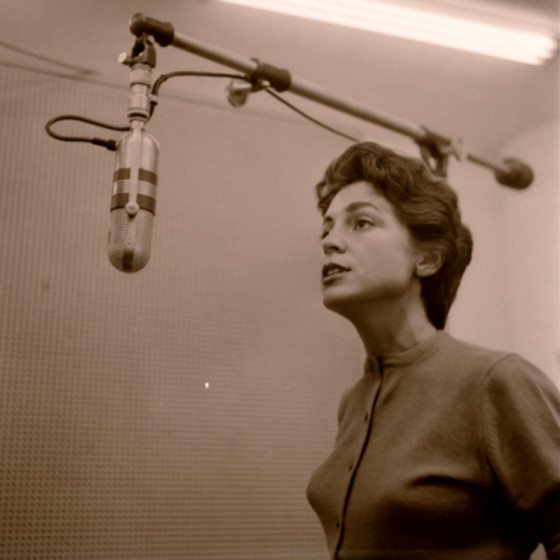
Shortly thereafter, in April 1949, Burton signed Doris to MGM Records. Within a week, she was standing in front of a microphone at MGM’s large studio, backed by a 25-piece orchestra that provided a rich accompaniment to her enchanting voice. The renowned arranger, composer, and conductor Harold Mooney, baton in hand, led her first recording session.
A July article noted, “Doris Drew really excites on her M.G.M. vocal disc debut in ‘A Rose Was a Rose’…,” while columnist Bill Driggs of the Los Angeles Mirror wrote: “Doris Drew, a newcomer on the MGM label, is one gal we hope makes the grade. Doris, you might say, is a happy medium between June Christy and Sarah Vaughan in her singing style. She is, nevertheless, a new and refreshing sound in the femme chirper field.”
A Billboard review of “A Rose Was a Rose” offered yet another comparison, observing: “New thrush has qualities of both Kay Starr and Doris Day as she gets a big beat-up for an unordinary sort of rhythm ditty.”
At the same time, Burton arranged for Doris to sign a booking contract with General Artists Corporation (GAC).
In June, Don Otis once again invited Doris to appear on one of his television programs on KLAC. From then on, under Burton’s tutelage, Doris kept busy recording new material for MGM. By popular demand, and billed as “The Singing Sensation of 1949,” she returned to Eddie Sure’s Oasis Club in early June 1949, delighting audiences while sharing the bill with Kay Kyser’s Orchestra. According to Hollywood reporter Virginia MacPherson, club owner Eddie Sure suggested that she enhance her figure by wearing artificial padding. Doris firmly rejected the idea.“He hired me to sing,” she snapped.“Not to sell sex. I don’t need padding. He’s just been around Hollywood too long. They’ve built up this phony bosom angle until any normal girl looks scrawny or something.”
MacPherson further reported: “Miss Drew says she may be put together wrong for this ‘sweater girl’ era, but she’s the ‘petite type,’ and petite she aims to stay—even if she has to make a test case of herself.”
That same month, it was also reported that Doris had been hired to sing and act in Borderline, a Universal-International film starring Fred MacMurray and Claire Trevor, in which she was also expected to perform the film’s title song. In the end, however, the project did not materialize, and the reasons remain unknown.
From July 23 through the end of August 1949, Doris appeared in a new show at San Francisco’s famous Club 365, owned by the jovial entertainment impresario and accordionist Bimbo Giuntoli, known affectionately throughout show business simply as “Bimbo.”
Doris then traveled to New Orleans, where she was engaged to appear at the Blue Room of the Roosevelt Hotel as one of the stars of the floor show, sharing the bill with singer Janet Brace and with Johnny Long and his orchestra. In his column for the Times-Picayune, Ed Brooks wrote: “Doris Drew, a very attractive brunette balladeer known to radio, stage, and screen audiences, took over to sing, blue and true, songs like ‘You Can Have Him’ and ‘Talk Fast, My Heart,’ which brought her back for a pair of encores in distinctive style, ‘Singin’ in the Rain’ and ‘Pennies from Heaven.’”
Another MGM release followed in November,“I Wish I WasBack in MyBaby’s Arms,” on which Doris was accompanied by an orchestra conducted by Earle Hagen, with the Jud Conlon Quintet. The record quickly became a favorite with disc jockeys.
Back in Los Angeles, on December 1, she appeared once again on television, this time as a guest on the popular Club Time show on KLAC. She also opened at Ciro’s, the fashionable Hollywood dining spot, where she remained for a month.
During her early years on the club circuit, Doris Drew was occasionally mentioned in society columns. One brief item published in December 1949 linked her romantically to actor Peter Lawford—a minor instance of media attention that neither continued nor had any discernible impact on her professional career.
In January 1950, billed as MGM’s Recording Star, she began an extensive tour of clubs and theaters throughout the eastern United States, including engagements in Canada.
Touring the country on her own as a solo attraction, her appearances included the Triangle Room at the Seventh Avenue Hotel in Pittsburgh; in February, the Lookout House in 19 Covington, Kentucky; and later Club Norman in Toronto.
Afterward, she traveled to Montreal, where she headlined the new Esquire Revue, enjoying a successful week in March that led to a second run in May. She then returned to Toronto, drawing enthusiastic applause from patrons at the Casino Theatre. In August, she appeared at the Flame Show Bar in Detroit for a limited engagement, followed in early October by a two-week headlining run in the new floor show at Club 509, also in Detroit. By then, Doris had clearly proven that she possessed not only beauty and a distinctive voice, but also genuine stage presence.
When she completed her tour in late November 1950, she was offered an engagement at Chicago’s London House. As a result of her performances there, Doris received her first significant radio break when singing star Johnny Desmond heard her and invited her to “fill in” one evening on his network broadcast, Johnny Desmond Goes to College, heard every Monday at 8:30 p.m. over WENR, the ABC outlet in Chicago. Desmond and his colleagues were so impressed by her distinctive style that she was invited back the following week, becoming a permanent member of the cast after her second appearance and signing on for a 13-week series.
Her impact on the Chicago program was immediate. In February, she signed a new recording contract with Mercury Records, and after Johnny Desmond Goes to College completed its run, she was soon given her own program, Dreamboat, on the ABC network— a new half-hour weekly show airing on Monday nights. The program starred Doris alongside Bill Santry, with musical support provided by Rex
Maupin’s Orchestra and the George Barnes Trio or Octet.
Dreamboat debuted on the ABC network on Monday, April 9, 1951, at 8:30 p.m., marking yet another high point in the career of the talented young singer from Texas. At just 23, Doris was already well on her way to establishing herself as a major presence in American popular entertainment. Having been under contract to General Artists Corporation for the previous two years, Doris signed a new agreement with Music Corporation of America in April. By then, her first releases for Mercury—”Beautiful Brown Eyes” and “Shut Up”—were already becoming popular on jukeboxes across the country. “Shut Up” was selected as “Best of the Week” by the Los Angeles Mirror on Saturday, March 24.
In late July 1951, Doris traveled to Rapid City, South Dakota, for a week-long engagement at the Black Hills Light Opera House, where she appeared accompanied by Carl Sands and his orchestra. In August, she went on to Cleveland, Ohio, performing first at the Alhambra Tavern and then at the new Alhambra Theatre as part of the entertainment season, billed as the new Mercury Records star. Beginning September 14, she appeared at Eddy’s in Kansas City, sharing the stage with harmonica virtuoso John Sebastian.
In early October, Doris returned briefly to her hometown of San Antonio to visit her aunt—”who raised me,” as she later noted—and her grandmother. “I was working in Denver, flew to San Antonio, then back to Denver and on to Des Moines,” she recalled. After completing the engagement, she headed to the West Coast for a short break before traveling to Montreal in late 1951, where she was engaged to appear at the Seville Room.
In late December 1951, Doris married Al Leibovitz, an up-and-coming young comedian known professionally as Larry Allen.
In late January 1952, Doris teamed up with her husband, Larry—billed as “America’s Kid Brother”—to perform at the Main Street Club in Cleveland, Ohio. From then on, the couple frequently appeared together. At the end of March 1952, they played a two-week engagement at the Brook Hollow Country Club in Oklahoma City, with Freddie Bunch’s Orchestra providing music for both the show and dancing.
On September 25, 1952, Doris and Larry announced the arrival of their son, Danny, who was born at Presbyterian Hospital in Chicago.
In 1953 Mercury would release more songs by Doris Drew, titles such as “Side by Side” in March, and “The Moon Is Blue” in August, which, backed by the orchestra conducted by David Carroll, were very well received by their fans.
In March 1953, Doris and Larry appeared at Club Topper in Akron, Ohio. Later that year, on November 27, Doris returned in person to Eddy’s in Kansas City, sharing the bill with George Gobel. She continued to attract attention with appearances at La Vie en Rose in New York and at the Chi Chi Club in Chicago.
In early April, she was back in Los Angeles, singing at Adolphe Remp’s Players Restaurant on the Sunset Strip. As her profile continued to rise, Doris began attracting increasing attention from radio and television producers. She was soon selected as the vocalist for Jack Carson’s new Tuesday–Friday radio program, which debuted on July 6, 1954, on the CBS network.
The four-times-a-week, 25-minute “chatter and music” show starred Carson, backed vocally by Doris and Tony Romano, with orchestral accompaniment directed by pianist and composer Walter Gross, who wrote the hit song “Tenderly.”
Cliffie Stone, who produced the program along with Milt Hoffman, later recalled hearing Doris at an audition. Doris herself remembered that she did not really know what she was auditioning for, but when she finished, Stone approached her and said simply, “You’ve got the job.” She subsequently became the new feminine attraction on the weekday NBC-TV program The Tennessee Ernie Ford Show, replacing Joan O’Brien, who stepped aside because of scheduling conflicts. Doris had appeared as a guest on several Tennessee Ernie programs in the preceding months before becoming a regular member of the cast when the show premiered on January 3, 1955, broadcast from the soundstage of the historic El Capitan Theatre. Vocal duties were shared by Tennessee Ernie Ford, Doris Drew, Molly Bee, and Skip Farrell, with musical accompaniment provided by Jack Fascinato and his orchestra.
Fascinato—one of Chicago’s most versatile musicians, proficient not only on piano but also on brass instruments, violin, viola, string bass, and timpani—relocated to Palm Springs, where he settled with his family to serve as musical director of Ford’s television show.
Doris soon became so busy with her new commitments that she had to turn down nightclub offers. Evening appearances had once been her main source of income, but she now simply did not have enough time to fit them into her schedule.
In their private life, the Allens were living in North Hollywood in a newly built ranch-style home, while Doris also kept busy as the mother of three-year-old Danny.
One article vividly described her demanding routine: “She does five shows a week for NBC-TV and five for CBS radio, warbles between 20 and 25 songs a week, and handles commercials and skits. To manage all this without winding up in a tight white coat, she keeps herself on a strict schedule—lights out at 9 p.m. nightly and up again at 5:30 a.m. She whisks off to NBC’s Burbank plant to rehearse the TV show, which goes on the air at 9 a.m. After that, she grabs a quick breakfast and rehearses the next day’s show until noon. Then she flits ten miles into Hollywood to rehearse the radio show until it’s taped at 2 p.m.”
Doris and Larry generally managed to work in the same cities, though as separate acts, and they often took baby Danny with them on their trips.
In the fall of 1956, Jack Fascinato decided, in his spare time, to make a series of recordings at his home studio. Some were instrumentals, while others featured Doris Drew singing ballads arranged in a highly unusual manner by Fascinato and delivered by Doris with a subdued, relaxed quality. Among the songs recorded were “The Moment We Met” and “I’m Alone but Never Lonely” (by Al Hoffman), the sophisticated Fascinato original “Abada-Abadu,” well-known standards such as “Tea for Two” and “There Will Never Be Another You,” the lesser-known “Be My Lovin’ Baby”—all heard on this compilation—as well as the rhythmic novelty number “French Fried Potatoes,” which is not included here.
That same year, Fascinato entered into a licensing agreement with Kahill Records, a small label based in Des Plaines, Illinois. The company released three 45 rpm singles: one instrumental and two featuring Doris. One release (KA-1015) included “Abada-Abadu” and “Be My Lovin’ Baby”; a second (KA-1025) paired “I’m Alone but Never Lonely” with “French-Fried Potatoes.” Two years later, in May 1958, Stepheny Records issued a 12-inch album (MF-4004) titled Jack Fascinato Arranges Things, which brought together the six Doris Drew ballads from those sessions.
Up to that point, Doris Drew’s recording activity had been relatively sporadic, limited mainly to the few singles she recorded for MGM, Mercury, and Kahill. The principal reason was her demanding schedule, which left little time for studio work until The Tennessee Ernie Ford Show came to an end on June 28, 1957.
Shortly thereafter, Red Clyde, producer for the newly founded Los Angeles label Mode Records, persuaded Doris to record her first LP. Clyde quickly arranged the sessions at Hollywood’s Radio Recorders studios, located at 7000 Santa Monica Boulevard, which took place over three days—September 10, 11, and 12, 1957. With orchestral accompaniment arranged and conducted by the incomparable Marty Paich—whose work helped define Doris’s distinctive vocal style—and with renowned engineer Dayton “Bones” Howe at the console, the project resulted in the album "Delightful Doris Drew" (Mode LP 126).
In the album’s original liner notes, Joe Quinn wrote: “Mode’s musical director, Marty Paich, was particularly eager to orchestrate and arrange for the Doris Drew sound because of the possibilities he saw in blending her tones with the instrumentations which characterize his work. A choice selection of tunes gave Marty an abundance of material from which he fashioned some of the finest charts of his career. Doris, too, felt an undercurrent of excitement in preparing for the date, and although she received the majority of the adulation for her performance, she was quick to credit Marty for ‘the finest arrangements I’ve ever heard.’
“Also present on this disc is an intense flair for words and expression, which is the direct result of Doris’ recently acquired training as a dramatic actress. With wide exposure to television and close proximity to motion pictures (her husband, Larry Allen, is a producer), Doris hopes to develop this talent sufficiently to point toward musical comedy. Moulding the delights of her first love, singing, with the challenging requirements of the legitimate theatre will be a great personal victory for this young woman who is firmly establishing her place as an entertainer.
“Two-thirds of our recorded program features an orchestra augmented by strings, and the other third is made up primarily of brass and rhythm instruments. With Marty Paich directing from the piano or celeste, the completely entertaining selection follows this pattern: “‘I’ve Got the Sun in the Morning’—With Marty’s piano prominent throughout, Doris fits easily through Irving Berlin’s swinger from Annie Get Your Gun. Alto by Herb Geller.
‘Cabin in the Sky’—Vernon Duke’s memorable composition from the similarly titled show receives a tender treatment from Doris. ‘There Will Never Be Another You’—Striking intonation by Doris with the orchestra is the feature here, as Harry Warren’s fine standard is treated in its original form.
‘Wrap Your Troubles in Dreams’—Right at home with this great rhythm tune, Doris glides effortlessly through the lyric. Don Fagerquist and Herb Geller divide midway. ‘He’s My Guy’—Recognizing the excellence of lyric and melody in this obscure composition, Doris conveys its emotional depth. ‘Once You Find Your Guy’—Another philosophical composition requiring sincerity, which Doris provides in full. Marty’s scoring creates the mood.
‘You and the Night and the Music’—Introduced in the 1934 production Revenge with Music, this sprightly item remains ever-fresh in Doris Drew’s modern reading. Dave Pell and Bob Enevoldsen are soloists.
‘If I Should Lose You’—The beauty of this composition is magnified by Doris’ deliberate handling of the lyric and the orchestra’s unity. ‘I Only Have Eyes for You’—Harry Warren co-authored this evergreen forthe 1934 show Dames. Doris and the strings capture every ounce of its sentiment. ‘I Cried for You’—One of the perennial rhythm tunes finds Doris in spirited form, with the same feeling permeating the band. Herb Geller and Don Fagerquist improvise the line. ‘I Love You’—Irving Berlin’s popular ballad from Miss Liberty enters the standard category through this impressive reading by Doris and the strings.
‘Something to Remember You By’—This nostalgic verse and melody, penned by Arthur Schwartz for the 1930 production Three’s a Crowd, receives a sensitive rendition that reaches the heart of the matter.
“The human voice remains the most sensitive and emotional instrument in music, and when it belongs to Doris Drew it gains the added dimension of profound interpretation. With Doris at Radio Recorders during the recording of her Mode album a poise that recalls the biggest names in the business, she has completed an album that is at once entertaining and inspiring. For Doris Drew, ‘making it big’ is only a matter of time.”
On November 18, 1957, Doris appeared as the guest vocalist on the television program Stars of Jazz, hosted by Bobby Troup. She was accompanied by the same group that had played on her Mode album, with Marty Paich on piano, although the ensemble on this occasion was directed by Don Fagerquist. Doris performed two numbers previously recorded for the album, “I Cried for You” and “He’s My Guy,” the latter presented without strings.
On Monday, May 2, 1958, Ernie Ford returned to the airwaves with The Tennessee Ernie Ford Road Show, broadcast weekdays at 4:00 p.m. on WGST. Once again, Doris Drew and Molly Bee alternated as the featured female vocalists, with the orchestra conducted by Jack Fascinato. In addition to singing, Doris also took part in the show by giving dance instructions.
That spring, Doris also began singing frequently with tenor saxophonist Dave Pell’s octet. A musician and entrepreneur, Pell—besides leading his well-known group—was also a record producer for Tops Records. He invited Doris to appear as a guest vocalist on sessions led by John T. Williams and Lew Raymond, recorded at Radio Recorders.
On May 22, at Radio Recorders, Pell brought together John T. Williams on piano, Ronny Lang on alto saxophone, Tommy Tedesco on guitar, Larry Bunker on vibraphone, Buddy Clark on bass, and Mel Lewis on drums. With this group, Doris recorded two tracks— ”Pennies from Heaven” and “Put the Blame on Mame”—creating an engaging swing treatment of these two popular standards.
Shortly thereafter, on September 25, 1958, Doris was featured in the Los Angeles debut of the television program The Sherwood Affair, broadcast on Channel 9. The weekly, hour-long show—taped on Tuesday nights—was hosted by Don Sherwood, dubbed “TV’s Bad Boy” by San Francisco columnists for his offbeat patter and occasional absenteeism at airtime.
Known as San Francisco’s most controversial television personality, Sherwood billed himself as the “World’s Greatest Disc Jockey.” On the program, Doris sang a medley as well as “Someone to Watch Over Me,” accompanied by the Allyn Ferguson Trio.
On April 12, took place at Radio Recorders, the mentioned session by the Lew Raymond orchestra, on which Doris sung on a couple of tunes You’re The Cream In My Coffee,” and “Life Is Just A Bowl Of Cherries.” The full recording came out on a Tops album titled Best of Old Broadway.
Doris later joined the cast of ABC-TV’s new program Music for Fun, which premiered on April 18, 1959, and was hosted by Joe Allison. Musical accompaniment was provided by a 16-piece band led by Bobby Hammack. Other featured singers on the show, in addition to Doris, included Marilyn Lovell, Jackie Paris, Med Flory, and Bill Carey.
Meanwhile, Doris continued as vocalist with the Dave Pell Octet, appearing at Catalina Island’s famed Casino in June 1960, as well as at private parties and special engagements through early 1962.
In June 1963, she made a brief comeback with an engagement at Dino’s Lodge in Los Angeles, the glamorous Sunset Strip restaurant closely associated with Dean Martin. Doris returned there in August for a two-week run.
After this final commitment, Doris gradually withdrew from the club circuit in order to devote herself to a more private life with her family, enjoying an active outdoor lifestyle and the simple pleasures of home, while still making the occasional performance.
In 1966, credited as Doris Drew Allen, she provided the singing voice for the title character in the ABC-TV animated special Alice in Wonderland, or What’s a Nice Kid Like You Doing in a Place Like This?, produced by Hanna-Barbera. (Janet Waldo supplied Alice’s speaking voice.) Doris later reprised the role for a record album based on the program.
Little else is known about her later activities. This account therefore focuses on the origins of her career and, above all, on the years in which the delightful Doris Drew developed and refined her distinctive voice as a singer.
—Jordi Pujol (From the inside liner-notes of 'The Doris Drew Story' FSRCD 1170)