Blue Sounds Stanley Dance FSR Blog
SHOPPING CART...  There are no items in your shopping cart

blue line
HOME -> Blue Moon Jazz -> Jazz Heat Bongo Beat
 
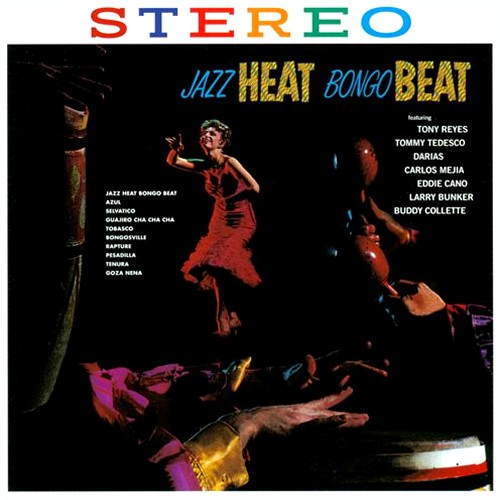
Jazz Heat Bongo Beat

Buy Now!

€ 9.95
(USD 11.83)


Jazz Heat Bongo Beat

Buddy Collette

Featuring: Buddy Collette (fl), Tony Tedesco (g), Eddie Cano (p), Tony Reyes (b), Larry Bunker (d), Carlos Mejia (bgos), Darias (cga)

REFERENCE: BMCD 1604
BAR CODE: 00


Tracklisting:

1. Jazz Heat Bongo Heat
2. Azul
3. Selvatico
4. Guajiro cha cha cha
5. Tobasco
6. Bongosville
7. Rapture
8. Pesadilla
9. Tenura
10. Goza Nena

Recorded in Los Angeles, 1959


Biography:

Pianist Eddie Cano spent most of his career connecting the dots between jazz and Latin styles. He found an appreciative audience for a series of albums under his own name released in the '50s and '60s by labels such as Atco, Reprise, and RCA, his following similar to that of vibraphonist Cal Tjader and bandleader Les Baxter. Cano also drew on dance crazes such as the cha cha and the Watusi to promote his efforts. His family was rich musically, Cano's father a bass guitarist, his grandfather a member of the Mexico City Symphony. Cano studied bass with his grandfather and private teachers, also studied piano and trombone, spent two years in the Army beginning in 1945, and then began hitting stages in a group led by Miguelito Valdés.

He soon made a connection with Herb Jeffries, a singer whose forte was balladry and with whom Cano would collaborate off and on over the next decade. The pianist had his own bands going as early as 1948, but continued working with Jeffries, Bobby Ramos, and Tony Martinez. As a composer, Cano came up with a large repertoire, including the tasty "Algo Sabroso," the friendly "Cal's Pals," the wiggly "Watusi Walk," and the thrilling "Ecstasy" — not to mention "Honey Do," which could be a cross-genre answer song to Carl Perkins' popular "Honey Don't." While many of his peers concentrated on the peerless thrust of Latin rhythms, Cano hardly ignored this component but seemed equally intent on emphasizing the kind of complex, provocative harmonic and melodic structures associated with modern jazz.

- by Eugene Chadbourne

blue line