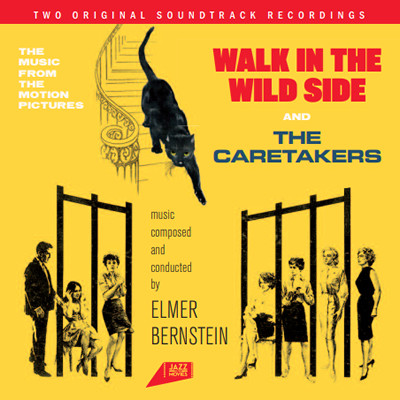
Two Original Soundtrack Recordings
JAZZ IN THE MOVIES presents the most celebrated scores by the composers that introduced jazz to motion pictures and television soundtracks. In addition to providing a superbly appropriate setting for dramatic scenes, all the jazz background themes were interpreted by many of the best Hollywood and New York jazz studio musicians.
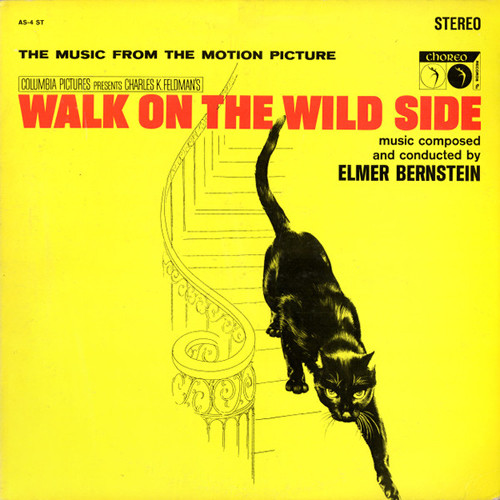
Walk on the Wild Side
From its striking main title through its aching melodies, blues-inflected laments, and unapologetically romantic climaxes, the score asserts itself as one of Bernstein’s most compelling achievements. His evocation of New Orleans is neither superficial nor decorative; it is grounded in muscular rhythms, harmonically expressive writing, and unmistakably blues-shaped melodic contours. Elmer Bernstein’s music for WALK ON THE WILD SIDE has lost none of its impact. Its strength lies in stylistic confidence and emotional clarity, with the music divided between full orchestra and jazz combo, functioning as a powerful expressive device rather than a mere stylistic conceit.
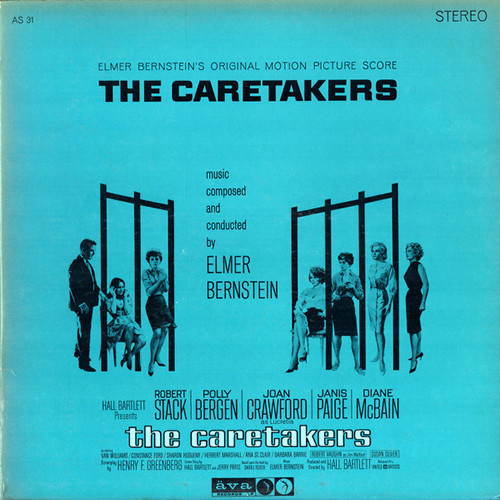
The Caretakers
One of the principal strengths of THE CARETAKERS lies in Elmer Bernstein’s accomplished score. The Oscar winning composer supplies music that captures the film’s tension and dramatic jazz-inflected atmosphere, notably in cues such as “Black Straight-Jacket” and “Party in the Ward.” Elsewhere, the writing adopts a lighter, more accessible tone in pieces like “Take Care,” “Blues for a 4-String Guitar,” and the notably danceable “Birdito,” which function as a relaxed interlude marked by the evident enjoyment of the jazz musicians involved. In contrast, the latter portion of the album shifts toward more overtly dramatic, programmatic material tied to the film’s harrowing moments. Though less immediately accessible, this music is ultimately more compelling, particularly the slow, string-driven cue “The Cage.” “Electrotherapy” stands out for its effective use of tuned percussion, and the score as a whole demonstrates Bernstein’s versatility across both lighter and darker idioms.
Tracklist
01. Walk on the Wild Side
02. Somewhere in the Used To Be
03. Hallie’s Jazz
04. Rejected
05. Doll House
06. Teresina
07. Night Theme
08. Walk on the Wild Side Jazz
09. Dove
10. Kitty
11. Oliver
12. Reminiscence
13. Finale
14. Walk on the Wild Side
15. Black Straight-Jacket
16. Blues for Four-String Guitar
17. Take Care
18. Birdito
19. Party in the Ward
20. The Caretakers
21. The Cage
22. Electrotherapy
23. Day Hospital
24. Seclusion
25. Finale
Album details
Sources:
Tracks #1-13, from the album “Walk on the Wild Side” (Choreo A4ST)
Track #14, from the Brook Benton single “Walk on the Wild Side” (Mercury 71925X)
Tracks #15-25, from the album “The Caretakers” (Ava AS-31)
“Walk on the Wild Side”
Orchestra Conducted by ELMER BERNSTEIN
Vince De Rosa, Dick Perissi, John Cave, French horn; Martin Ruderman, Sylvia Ruderman, flute; Lurie Mitchell, Ted Nash, clarinet; Arnold Koplenz, Gene Cipriano, oboe; Jack Marsh, Norman Herzberg, bassoon; Giovannini Caesar, piano; Abe Luboff, bass; Louis Singer, percussion; Anatol Kaminsky, Israel Baker, Irma Neumann, Nathan Kaproff, George Kast, Felix Slatkin, Ralph Schaefer, Alex Murray, Ambrose Russo, Benny Gill, violin; Virginia Majewski, Robert Ostrovsky, Cecil Figelski, viola; Armand Kaproff, Edgar Lustgarten, Kurt Reher, cello; Dorothy Remsen, harp.
Jazz Sextet [#1, 3 , 5 & 10]
Pete Candoli, trumpet; Buddy De Franco, clarinet; Jimmy Rowles, piano; Bob Bain, guitar; Red Mitchell, bass; Alvin Stoller, drums.
Recorded at United Recorders, Los Angeles, February 8 & 9, 1962
Brook Benton, vocals, with Orchestra Conducted by Stan Applebaum [#14 ]
Recorded in New York City, 1962
“The Caretakers” [#15-25]
Orchestra Conducted by ELMER BERNSTEIN
Bud Brisbois, trumpet; Dick Perissi, French horn; Ted Nash, alto sax; Dick Noel, Lloyd Ullyate, trombones; George Roberts, bass trombone; Buddy Collette, Gene Cipriano, reeds; Red Mitchell, bass; Bob Bain, guitar; Lou Singer, percussion; Anatol Kaminsky, violin; Virginia Majewski, viola; Dorothy Remsen, harp.
Recorded at RCA Victor studio in Hollywood, Los Angeles, 1963
Full personnel & recording details in the CD booklet
Original Choreo and Ava recordings produced by Jackie Mills & Tommy Wolf
Compiled and produced for CD release by Jordi Pujol
© 2025 by Jazz in the Movies / Fresh Sound Record
Stereo · 24-Bit Digitally Remastered
Blue Moon Producciones Discograficas, S.L.