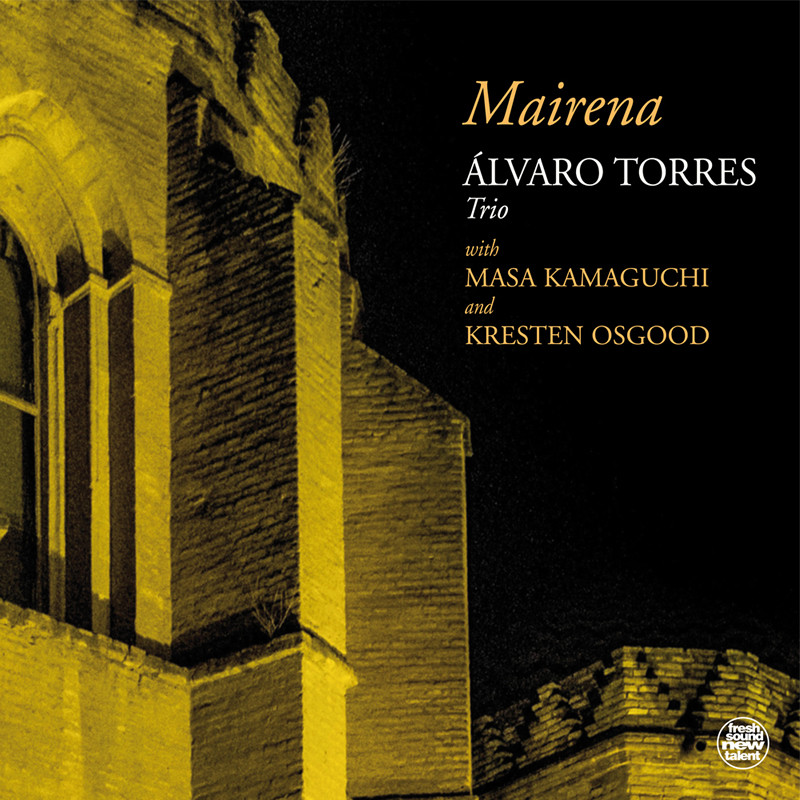
Many of us artists who come to New York face certain dilemmas related to our own folklore: our relationship with our roots and with the different kinds of music we’ve absorbed over the years. Forme, it’s clear that identity can evolve over time. In my case, I feel drawn to flamenco and other folk traditions in a way that differs from how I relate to European classical music—my roots—and is also distinct from my love of jazz and improvised music, which have been my greatest passion since adolescence.
Among these three worlds, I’m gradually finding my place, trying to be honest and unafraid to blend paths where clear references don’t always exist. This trio with Masa Kamaguchi, Kresten Osgood and myself began taking shape in 2023, and in the summer of 2025 we went on a nine-concert tour across Spain. The music included here was recorded at Café Berlín in Madrid (#1, 2 and 5) and at the Centro Andaluz de Arte Contemporáneo in Seville, in a concert organized by Assejazz (#3, 4 and 6).
The piece that gives the album its title, Mairena, refers to Juan de Mairena, an apocryphal character created by the Spanish poet Antonio Machado. Through this alter ego, Machado reflects on politics, philosophy and, above all, on the complexity of embracing Spanish culture and folklore—with all its contradictions—from a critical perspective and with a generous dose of humor.
Almost a century later, his vision still strikes me as remarkably lucid, resonating with my own dilemmas as an artist trying to reconnect with his folklore in his own way. Other pieces on the album include Calabosito, inspired by Camarón de la Isla; Lisbon Mood, dedicated to Aaron Parks; and Llum Verda, The Good Life and Everything I Love, which reflect our passion for improvisation.
—Álvaro Torres
Tracklist
01. Llum Verda (Álvaro Torres) 6:59 02. Mairena (Álvaro Torres) 7:03 03. Calabosito (Álvaro Torres) 7:34 04. Everything I Love (Cole Porter) 9:11 05. Lisbon Mood (Álvaro Torres) 8:25 06. The Good Life (Álvaro Torres) 5:10
Album details
Personnel: Álvaro Torres (piano), Masa Kamaguchi (bass), Kresten Osgood (drums). Recorded live at Café Berlín, Madrid, August 7, 2025 (#1, 2 & 5). Recorded live at Centro Andaluz de Arte Contemporáneo, Sevilla, August 12, 2025 (#3, 4 & 6).
Mixed by Sergi Felipe Mastered by Pieter De Wagter Photos: Gracia Gata / Carlos Linero
Produced by Álvaro Torres Executive Producer: Jordi Pujol
"Spanish pianist Alvaro Torres is quite explicit in his connection to flamenco tradition, but as a jazz musician he honors that folk heritage by internalizing its sound and forging something fresh with it.
The pianist lives in New York, where he’s built a fruitful bond with bassist John Hébert and drummer Barry Altschul, but he keeps his European connections alive, working closely with the excellent Danish drummer Kresten Osgood, who brings crisp precision, loping drive and time-fracturing energy to this superb live recording taped at gigs in Madrid and Seville in the midst of a 2025 European tour with bassist Masa Kamaguchi. His post bop chops are clear, but what distinguishes this trio is the halting flow.
The brooding “Calabosito” was inspired by the legendary flamenco singer Camarón de la Isla, but elsewhere the genres influence is more oblique, deployed through rhythm and the silences embedded within them.
On these six original tunes Torres builds in pauses and dynamic space, a kind of two- gear rubato that makes the music lurch and stop, with a similar strain of hurtling force that makes its propulsion so exciting and unpredictable.
The melody on “Mairena” unfolds in terse stabs, leaving the rhythm section to chatter quietly between phrases. That method brings a delicious tension to the proceedings, bringing a volatility to a fairly direct post-bop sensibility.
In fact, as tuneful and harmonically sleek as Torres is, its his sense of time and the rhythmic invention of his phrasing that distinguish his playing here.
—Peter Margasak Down Beat (July, 2026) _________________________________________________________________________________________
"Álvaro Torres laid the groundwork for his jazz journey in a common way (for this uncommon profession): by studying classical piano from a young age. The aspect of improvisation pulled him away from the classical world, into a globe-trotting search based in Spanish folkloric and Hindustani music and jazz and a Master's degree at the Manhattan School of Music.. He blends these diverse forms of musical expression on Mairena.
The Spanish-born and New York-based Torres uses the piano trio—with bassist Masa Kamaguchi and drummer Kresten Osgood—to express his multicultural vision.
Torres cites the influence of Ornette Coleman, Paul Bley, Johannes Brahms and Isaac Albeniz. Bley seems especially apt. Torres' approach has a Bley-like, jumbled-forward feel. Compositionally. Coleman does indeed come to mind, with a boldness and devil-may-care approach to melody and a trio dynamic that is as interactive as it is unpredictable.
"Lum Verda" opens the disc on an insouciant note, the trio members jostling along then giving way to a pensive bass solo comped by lively yet understated drum work. The title tune, based on a character created by Spanish poet Juan Machado, is by turns riotous and poignant and pensive.
The album was recorded in 2025, during the trio's Spanish tour on stops in Madrid and Seville. The tunes—all except one—are Torres originals. They mix his various influences nicely. The lone cover, Cole Porter's "Everything I Love" injects a dose of familiarity into the novelty of the leader's original tunes. Even so, improvisation rules on the American Songbook gem as well as on the Torres-penned compositions. The trio is on a search as they craft this complex music that remains approachable and engaging from start to finish."