Géo Daly
Vibraphonist Géo Daly (April 16, 1923, Bois-Colombes- June 1, 1999 Sète) was one of the most distinctive voices of postwar French jazz. Gifted with impeccable technique, a bright, propulsive sound, and a constant urge to evolve, he emerged in the late 1940s as the leading French exponent of the vibraphone, bringing to the instrument both the exuberance of Lionel Hampton and a modern European sensibility of his own.
At the age of eight, Daly was given an accordion, the instrument on which he began his professional career in 1941. During the Occupation he performed in quartet settings devoted to the music of Benny Goodman, recreating Hampton’s celebrated vibraphone parts on accordion with remarkable flair.
Before the end of the war he entered the orbit of the American forces and, at the Liberation in 1945, acquired a vibraphone—still a rarity in France—left behind by a departing...
Vibraphonist Géo Daly (April 16, 1923, Bois-Colombes- June 1, 1999 Sète) was one of the most distinctive voices of postwar French jazz. Gifted with impeccable technique, a bright, propulsive sound, and a constant urge to evolve, he emerged in the late 1940s as the leading French exponent of the vibraphone, bringing to the instrument both the exuberance of Lionel Hampton and a modern European sensibility of his own.
At the age of eight, Daly was given an accordion, the instrument on which he began his professional career in 1941. During the Occupation he performed in quartet settings devoted to the music of Benny Goodman, recreating Hampton’s celebrated vibraphone parts on accordion with remarkable flair.
Before the end of the war he entered the orbit of the American forces and, at the Liberation in 1945, acquired a vibraphone—still a rarity in France—left behind by a departing serviceman. It proved to be the decisive turning point of his musical life. He completed his military service as a bandleader at the Inter-Allied Club, directing the orchestra of the theatre attached to the American forces.
After further cabaret engagements, Daly performed for American troops in Germany, steadily refining his style. A disciple of Hampton, he developed a language full of drive, riffs, and infectious swing, yet balanced by uncommon harmonic and melodic invention. Added to this was a formidable technique that soon set him apart from his contemporaries.
He travelled widely—to Switzerland, back to Germany, and on to Lebanon—and by the time he appeared at the Théâtre Édouard VII in Paris with his own orchestra, he was still virtually unknown to the French public. That anonymity would not last for long.
In the fall of 1948, Daly and alto saxophonist Michel de Villers joined the ensemble known as the Edwards Band, then regarded as one of the major jazz attractions in Europe and organized by the promoters of the Jazz-Parade concert series held at the Théâtre Édouard VII. The group was a septet featuring trumpeter Bill Coleman, tenor saxophonist Don Byas, and a rhythm section made up of Bernard Peiffer on piano, Jean Bouchety on bass, and Roger Paraboshi on drums. Together they embarked on a memorable tour through France and Switzerland.
Michel de Villers, who had already appeared on the touring circuits of Django Reinhardt and Rex Stewart, returned with a notably matured sound and drew prolonged applause after each of his solos. He communicated emotion with easy flow and relaxation in ballads, and fiery blowing on up-tempo numbers. Yet it was Géo Daly who made the strongest impression on Swiss audiences, where he had been little known before those concerts. His performances, close in spirit to the style of Lionel Hampton, of Moonglow, Flying Home, and Paris–Monte-Carlo—the latter played four hands with Peiffer—aroused tremendous enthusiasm. Back in Paris, however, internal disagreements brought the Edwards Band to an abrupt end by the close of the year.
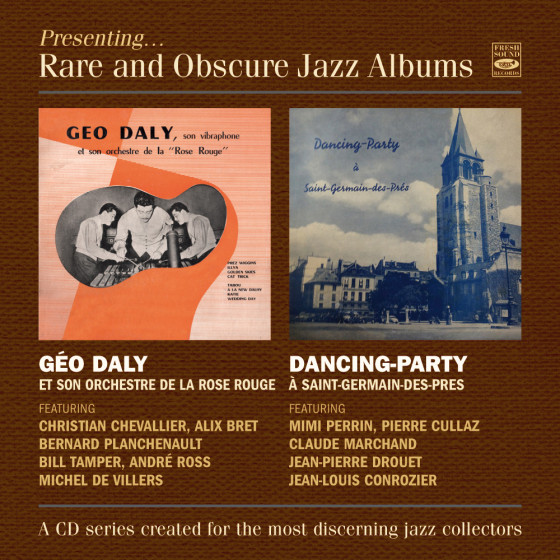
Daly and De Villers then moved on to La Rose Rouge, on Rue de Rennes in Saint-Germain-des-Prés, the cabaret that, since its opening in September 1948, had become the hottest address in Parisian nightlife.
Both men already enjoyed reputations as established soloists, and there they found the ideal set ting in which to forge one of the most fruitful partnerships in postwar French jazz. They remained for six successful years, becoming central figures in a venue where modern jazz found both shelter and prestige.The group that formed around them was not assembled by management decree, but grew naturally out of personal and musical affinities.
Musicians joined one by one, chosen by those already in the band, until an extraordinary unity emerged. After years of working together, that rapport came to be regarded as virtually unmat ched in the history of French jazz.
At its heart stood an exemplary rhythm section. On piano was often the young Christian Chevallier, already alert to new musical currents and destined to become a major name on the French scene. On bass was Alix Bret, and on drums Bernard Planchenault, universally known as Monsieur Tempo.
Chevallier had discovered jazz only a few years earlier and embraced it with immediate fervor after hearing pianist Jack Diéval on the radio. He moved to Paris determined to become a jazz musician, surviving at first through dance jobs and musette engagements. Gradually he found his place on the Paris scene, appearing with Raymond Fonsèque’s Original Jazz Band, later at Le Tabou alongside Don Byas, and eventually, in 1951, joining Géo Daly’s La Rose Rouge orchestra, where he remained for four years, succeeding pianist Henri Patterson. His steady engagement there allowed him to pursue modern jazz more seriously, and after hours he could often be heard in late-night sessions with Bobby Jaspar, Fats Sadi, and Jimmy Gourley. By 1953 he had already begun to make his mark as an arranger, contributing originals such as Wedding Day and writing increasingly sought-after charts for leading French musicians and radio productions.
Planchenault was, for many French musicians of the day, the most admired drummer in the country. Mention his name and one would invariably hear the sameverdict: the man swung—andabove all, he knew how to accompany. That was his supreme gift. He never treated the drums as a personal showcase, but as the art of supporting, driving, and enhancing the soloist. He possessed the rare ability to put an improviser at ease, to suggest without intruding, and to draw the best from those around him. His pulse was firm, supple, and deeply musical. He was a drummer because he loved accompaniment.
Beside him, Alix Bret embodied a similar philosophy. He was the very image of calm, balance, and intelligence. Nothing in him resembled the boisterous or impulsive stereotype so often associated with musicians. Only when he took up the doublé bass did his true nature fully reveal itself. A tireless worker and disciplined instrumentalist, Bret belonged to that rare breed of bassists whose ambition was not to play dazzling solos, but to build the ideal rhythm section.
His playing was exact, solid yet flexible. Every note fell naturally into place; every line sounded clear in intention and effortless in execution. He always gave the impression of knowing exactly what he was doing and precisely where he was going. Those who knew him said the same was true in life.
Together, Bret and Planchenault formed one of the most admirable rhythm tandems of their time. Neither sought the pompous title of soloist; both preferred the discreet, essential craft of accompaniment. Yet together they became a machine of precision: a foundation of complete trust, probably the most reliable rhythm section in Europe and, for some contemporaries, the closest thing to the ideal then to be heard anywhere. Their compact ness, time, and understated creativity gave the band exceptional strength.
It was also during those years that Michel de Villers turned increasingly to the baritone saxophone, reflecting his desire for more modern sounds and broader musical expression. The change marked a clear search for a more modern sonority, abroader language, and a more distinctive timbralidentity. Before long, the baritone would become inseparable from his name.
For his part, Géo Daly was widely regarded as the foremost French vibraphonist of his generation, both for his technical command and for the individuality of his style and sound. He possessed two essential qualities in abundance: drive and the capacity to evolve. His music had nerve, clarity, and a constant desire to move forward.
Among the regular figures at La Rose Rouge were also tenor saxophonist André Ross and American trombonist Bill Tamper, frequent collaborators and notable presences on those Paris nights.
The April 5, 1953 Vogue session stands as testimony to that especially fertile period. Most of the compositions were by Christian Chevallier and several were performed by an expanded ensemble larger than the usual Rose Rouge unit, with the addition of De Villers and the participation of Tamper and Ross. The arrangements, pleasant and simply written, revealed a clear striving for refinement that was already beginning to bear fruit. It had become increasingly evident that young French musicians were making considerable progressin the recording studio, perhaps simply because they were finally being given more opportunities to record.
Reviewing the original 10-inch album in Jazz Hot, Michel Delaroche wrote: “Prez Wiggins opens the program as a successful piece touched by Cuban accents. It is followed by Illya, a number of muted mood and restrained colors, nostalgic and dream like, while Golden Tricks, at medium tempo, gives Daly ample room for expression. Cat Trick closes the first side with attractive unison passages and particularly careful writing.
On the reverse side, Lecuona’s veteran Tabou receives a rejuvenated and lighter treatment, with delicate brush work that allows Chevallier to be heard at the piano, along with an almost fugal duet between piano and vibraphone—one of the finest moments of the record. A la New-Dalhy opens with a fine arrangement and finds Daly stretching out with obvious joy. Katie, a slow theme, is introduced by the vibraphone over care fully measured rhythmic punctuation and once again gives Géo center stage. Finally, Wedding Day brings the full orchestra back for a jubilant close, with appearances by Tamper, Ross, and de Villers—perhaps Heard too Little elsewhere on the album. There remains only on reservation: on that final piece, the power of the band seems greater than what the recording manages to capture. On a 33 rpm disc, one might have expected better from the studio.”
The last two tracks, The Day of a Dog and The Night of a Cat, were recorded two years later, with Daly fronting a large, hard-swinging orchestra. The Day of a Dog was a Daly original, while The Night of a Cat was composed by pianist Raymond Le Sénéchal. The leader was naturally the principal soloist, though the session also featured rewarding solo contributions from several members of the band. Particularly noteworthy were the spirited blowing of trumpeter Fred Gérard, whose tone and drive were impressive, the robust work of trombonist Benny Vasseur, and Le Sénéchal’s own tasteful and intelligent piano statements.
Whatever their minor imperfections, these performances still preserve the elegance, momentum, and esprit of an era when Paris breathed jazz until dawn.
—Jordi Pujol (From the inside liner notes of FSRCD 1086)